


Chemicals of Concern List Development

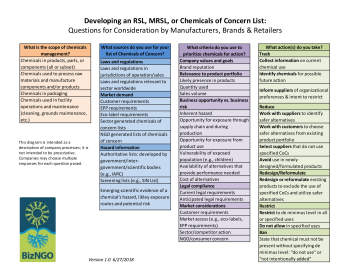
Developing an RSL, MRSL, or Chemicals of Concern List: Questions for Consideration by Manufacturers, Brands & Retailers

This diagram is intended as a description of company processes; it is not intended to be prescriptive. Companies may choose multiple responses for each question posed. …

The Retailer’s Guide to Safer Chemicals and Materials

Retailers need to move beyond regulatory compliance if they are to meet customer expectations for safer chemicals in products, respond to investor inquiries, and achieve favorable profiles in rankings by advocacy groups. But, "There are… …

Chemical Ingredient Transparency In Products: Review of Existing Public Policies & An Industry Standard

Learn the different types of chemical ingredient disclosure policies as well as their requirements. Read the report written by the Northeast Waste Management Officials' Association (NEWMOA) Interstate Chemicals Clearinghouse (IC2) and Clean… …

RSL Development

The BizNGO Chemicals Management Work Group developed a set of questions for consideration by manufacturers, brands, and retailers when developing a list of chemicals of concern that can be used as the basis of an RSL or MRSL. …

2019 Chemical Footprint Project Annual Report

Highlights from the 4th annual Chemical Footprint Project (CFP) report include: Reducing their footprint—the six frontrunners in the 2019 CFP Survey all scored greater than 85% of possible points, and are returning companies and disclosure… …

A Guide to Purchasing PFAS-Free Food Service Ware

Learn about the resources on our free webinar September 6th at 12 pm ET. Make more informed food service ware purchasing decisions: Fact sheet: Hazards of PFAS  Fact sheet: Purchasing Safer Compostable Food Service Ware Table: PFAS-Free Food… …

Alternatives to PFAS-Coated Food Packaging

Nonstick chemicals known as per- and poly-fluorinated alkyl substances (PFAS) are commonly used in disposable food packaging and food service ware as an oil and grease barrier. Concerns about their hazards are creating demand among grocery stores and… …

TV Reality: Toxic Flame Retardants in TVs

Televisions have historically contained large amounts of flame retardants, which scientists believe has contributed to the presence of toxic flame retardants in the home environment. Makers of televisions don’t have to report what chemicals are… …

The Plastics BAN List

An analysis and call-to-action to phase out the most harmful plastic products used in California. Download the report. …

BizNGO-Chemical Footprint Conference 2015 Selected Speaker Interviews

Check out these selected speaker interviews from the 2015 BizNGO-Chemical Footprint Conference! Nicole Koharik Nicole Koharik, serves as the global sustainability marketing director for GOJO Industries, a global leader in… …

Alternatives to Methylene Chloride in Paint and Varnish Strippers Report

Download the entire report Read more about Model Assessments and download individual chapters New Report: Alternatives to Methylene Chloride in Paint and Varnish Strippers: Availability of Safer Alternatives & Requirements for Meeting Stage 1 of… …

Trending Topics: Hazard? Risk? Do you know the difference?

A subject that comes up frequently in the context of managing and choosing chemicals, particularly for downstream users, is that of hazard and risk. With this piece we start what will be a series on the topic, particularly as it applies to… …

UNEP Report: The Business Case for Knowing Chemicals in Products & Supply Chains

Key messages: Regulatory requirements, customer demands, media attention, non-governmental organization advocacy, product recalls, and market opportunities are driving companies to know more about the chemicals in their products and supply chains.… …

Plastics Scorecard

The Plastics Scorecard v.1.0 offers the first comprehensive method for assessing and reducing chemicals of high concern in plastics. “From baby bottles made with BPA to medical devices made with DEHP, plastics are a surprising source of… …

Interstate Chemicals Clearinghouse Guidance Document

On January 8, 2014, the Interstate Chemicals Clearinghouse (IC2) and participating states announced the release of the IC2 Alternatives Assessment Guide (Guide). The Guide is the product of 20 months of effort by IC2's members. …

Principles for Safer Chemicals

Demand for products made from greener chemicals is growing rapidly. Consumers, investors and governments want chemicals that have low to no toxicity and degrade into innocuous substances in the environment. Leading businesses are seeking to capture… …

Commons Principles for Alternatives Assessment

Addressing Chemicals of Concern to Human Health or the Environment Alternatives Assessment is a process for identifying, comparing and selecting safer alternatives to chemicals of concern (including those in materials, processes or technologies) on… …

The Guide to Safer Chemicals

The Guide Marks pathways to safer chemicals in products and supply chains. Sets relative benchmarks for each of the four BizNGO Principles for Safer Chemicals Specifies actions for each benchmark Presents examples of business practices Illustrates… …

Principles for Sustainable Plastics (PDF)

BizNGO has developed principles for sustainable plastics …

Plastic Icebergs: Navigating the PVC Conundrum

Plastic icebergs: Navigating the PVC conundrum. Read this information blog post by Mikhail Davis and Lindsay James on GreenBiz.com. …

Chemical Alternatives Assessment Protocol (PDF)

Describes a process for identifying alternatives to a chemical of concern, screening out equally hazardous alternatives, and selecting an alternative. …

The Business Case for Comprehensive TSCA Reform

The Business Case for Comprehensive TSCA Reform. …

Dignity Health: Healthy Chemicals, Healthy Patients—Why Health Care Needs Federal Chemicals Reform

Dignity Health: Healthy Chemicals, Healthy Patients—Why Health Care Needs Federal Chemicals Reform. …

Construction Specialties: Green Buildings Need Safer Chemicals Policy Reform

Construction Specialties: Green Buildings Need Safer Chemicals Policy Reform …

Seventh Generation: Safer Chemicals Policy Reform—Bringing Transparency to Chemicals Management

Seventh Generation: Safer Chemicals Policy Reform—Bringing Transparency to Chemicals Management. …

Business and Advocacy Groups Create a Road Map for Safer Chemicals

The BizNGO Principles for Chemicals Policy Abstract This paper details how businesses and environmental organizations are collaborating to define and implement a visionary agenda for integrating safer chemicals into products, describing the… …

Nike

As part of Nike sustainability initiatives, the GreenScreen® is used to assess the hazards of chemicals used in products. …

BizNGO Letter to Senator Lautenberg

BizNGO Letter to Senator Lautenberg urging renewed focus on chemical ingredient disclosure. …

The Need for Chemical Ingredient Disclosure Across the Supply Chain.

The Need for Chemical Ingredient Disclosure Across the Supply Chain. …

BizNGO Principles – New Solutions article

Businesses and Advocacy Groups Create A Road Map for Safer Chemicals: The BizNGO Principles for Chemicals Policy By: Mark Rossi, Cheri Peele & Beverley Thorpe This paper details how businesses and environmental organizations are collaborating to… …

Safer Chemicals Policy Reform Notes to Congress

Safer Chemicals Policy Reform Notes to Congress. …

Oral Testimony, Howard Williams, Construction Specialties at House Bill Hearing

Oral Testimony of Howard Williams, Construction Specialties at House Bill Hearing. …

Bromine Free Semiconductor Chips

Silicon Storage Technology, Inc. was one of the first electronics companies to produce bromine-free semiconductors. The most formidable hurdle the company had to overcome was discovering a bromine-free molding compound to encapsulate its… …

Bromine and Chlorine Free Mobile Phones

Sony Ericsson’s phones are now 99.9% bromine and chlorine-free, and the company plans to end its use of PVC in external charging systems by the end of 2009. Sony Ericsson’s decision to cease using halogens in its phones was motivated by… …

Bromine and Chlorine Free Hard Disk Drives

Seagate is the world’s largest manufacturer of hard disk drives, and approximately 50 % of the disk drives Seagate ships today meet halogen-free specifications. Hard disk drives comprise several hundred individual components that Seagate… …

Bromine and Chlorine Free Printed Circuit Boards (PCBs)

Nan Ya and Indium both surmounted numerous obstacles to achieve their ultimate successes in producing bromine and chlorine-free materials for use in printed circuit boards (PCBs). Nan Ya is the world’s largest supplier of the rigid laminates… …

Bromine and Chlorine Free Plastic Components

DSM Engineering Plastics was one of the first chemical companies to offer a range of halogen-free products that can be used in electronics. DSM Engineering Plastics overcame technical, performance, and cost challenges to produce its new bromine and… …

Restriction of Elemental Bromine and Chlorine to Achieve Elimination of BFRs and PVC

Apple restricts nearly all uses of brominated and chlorinated compounds, at the elemental level, from its products. Customers can now purchase products like the iPod shuffle, nano, and touch, and the iPhone that are free of brominated flame… …

Greening Consumer Electronics Report

Moving away from bromine and chlorine Electronics manufacturers, standards bodies, and legislators have begun to take notice of the human health and environmental concerns associat­ed with the use of brominated and chlorinated compounds in… …

Lowell Center for Sustainable Production’s Framework for Alternative Assessment

Designing a truly sustainable product is a huge challenge in modern society. Nevertheless, many companies are striving to continuously improve the sustainability of their products as consumer demand for safe, healthy, and green products is rising. …

Greening Consumer Electronics - Executive Summary

This report features seven electronics companies (two major consumer electronics companies, and five component suppliers) that have moved beyond compliance with regulatory mandates and engineered environmental solutions that negate the need for most… …

Apple’s chemicals policy

Apple Inc.’s commitment to re-engineer all of its products worldwide to remove elemental forms of bromine and chlorine marks an important landmark in the electronics sector. …

Avalon Natural Products: Consciousness in Cosmetics

Since its founding in 1989, California based Avalon Natural Products has been a leader in making cosmetics from natural and organic ingredients. Avalon sells mainly in the organic and natural foods market, through stores such as Whole Foods and Wild… …

Interface Fabric: Benign by Design

Terratex PLA represents Interface’s latest innovation on the company’s journey towards sustainability. Launched in 2004 as the first commercial interior fabric made from 100 percent renewable biopolymers, Terratex PLA is used in window… …

H&M: Fashion Chemistry

You’ve got to have your supply chain aligned to manage chemicals in retail fashion. In this fast moving industry, designs sell out in six months. With this high turnover rate, fashion companies like H&M never design the same product twice.… …

Herman Miller: Healthy Chairs

Long before green design became popular, a culture that would nourish it had formed at Herman Miller. Product design at Herman Miller has long been seen in the light of constraints, problem solving, and long-term value. The designer Charles Eames,… …

Dell Inc.: Mainstreaming the Precautionary Principle

In the mid 1990’s, Dell shipped its first computers and displays free of a host of toxic brominated flame-retardants. Since then, Dell has worked with its customers, regulators, investors and environmental advocates to develop a broader list of… …

Premier: Choosing Safer Products Helps Improve the Health of Communities

The Premier healthcare alliance is committed to protecting the environment and maintaining a safe and healthy climate for patients, workers and communities. Premier and its members are leaders in the industry, setting the bar for environmentally… …

Perkins+Will: Taking a Precautionary Approach to Chemicals in Products

At Perkins+Will we design structures that achieve our clients’ vision while maintaining the company’s founding principles of sustainability, integrity and design excellence. …

Novation: Supporting Safer Products in Health Care

Novation is committed to helping hospitals create an environment free from hazards posed by chemicals that are harmful to humans, animals, and the environment. Chemicals management is a considerable undertaking for the health care industry, largely… …

Kaiser Permanente: Using Safer Chemicals in Products Supports Preventive Health Care

Environmental activism emerged within Kaiser Permanente four decades ago when the organization invited Rachel Carson to deliver the keynote address to a large symposium of physicians and scientists. Today the 8.5 million member organization with… …

Healthy Business Strategies for Transforming the Toxic Chemical Economy

This report profiles six companies that are crafting healthy strategies for using chemicals and materials in their products.  While their individual actions to address toxic chemicals vary, their best practices, when gathered together define the… …

Brominated Flame Retardants in Dust on Computers

In 2004 the first nationwide tests for brominated flame retardants in dust swiped from computers  in public buildings in 8 US states, revealed that computers are likely to be a significant source of deca-BDE  and other brominated flame… …