

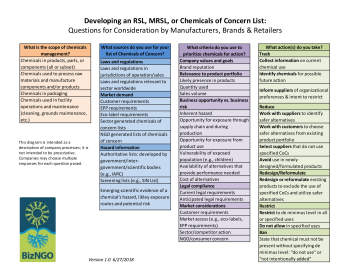



Developing an RSL, MRSL, or Chemicals of Concern List: Questions for Consideration by Manufacturers, Brands & Retailers
This diagram is intended as a description of company processes; it is not intended to be prescriptive. Companies may choose multiple responses for each question posed. …
Retailers need to move beyond regulatory compliance if they are to meet customer expectations for safer chemicals in products, respond to investor inquiries, and achieve favorable profiles in rankings by advocacy groups. But, "There are… …
Did you know we spend over 90% of our time indoors? And that exposure to some hazardous chemicals is actually higher indoors? That is why the chemical ingredients in the products we put into our homes and workplaces is a priority concern. Furniture… …
The GreenScreen Certified® Standard for Furniture & Fabrics to meet growing demands for certified environmentally preferable products in healthcare and beyond. Products covered by the new GreenScreen Certified Standard include desk systems,… …
Learn the different types of chemical ingredient disclosure policies as well as their requirements. Read the report written by the Northeast Waste Management Officials' Association (NEWMOA) Interstate Chemicals Clearinghouse (IC2) and Clean… …
The BizNGO Chemicals Management Work Group developed a set of questions for consideration by manufacturers, brands, and retailers when developing a list of chemicals of concern that can be used as the basis of an RSL or MRSL. …
The GreenScreen Certified™ Standard for Firefighting Foam is the first ecolabel for PFAS-free firefighting foam products. The certification prohibits the use of PFAS. PFAS is a class of ‘forever chemicals’ that can persist in… …
Learn about the resources on our free webinar September 6th at 12 pm ET. Make more informed food service ware purchasing decisions: Fact sheet: Hazards of PFAS Fact sheet: Purchasing Safer Compostable Food Service Ware Table: PFAS-Free Food… …
Nonstick chemicals known as per- and poly-fluorinated alkyl substances (PFAS) are commonly used in disposable food packaging and food service ware as an oil and grease barrier. Concerns about their hazards are creating demand among grocery stores and… …
Televisions have historically contained large amounts of flame retardants, which scientists believe has contributed to the presence of toxic flame retardants in the home environment. Makers of televisions don’t have to report what chemicals are… …