


BIZNGO 2026 Annual Meeting Cancelled

December 2–3, 2026 Cambridge, Massachusetts Dear Friends of Clean Production Action and the BizNGO Community, We are writing to share that CPA has made the difficult decision not to hold the BizNGO Annual Meeting in 2026. This decision was made… …

New sustainability ranking reveals the chemical footprint of 35 chemical producers

Today, the environmental NGO ChemSec released a new corporate benchmarking tool—ChemScore that measures the chemical footprint and other sustainability metrics of 35 of the world’s largest chemical companies. Through ChemScore,… …

Black Lives Matter - Justice, Peace, & Solidarity

Dear reader, The murders of George Floyd, Ahmaud Arbery, Breonna Taylor, Freddie Gray, Trayvon Martin, Tamir Rice, Eric Garner, Michael Brown, Philando Castile, Stephon Clark, and so many more starkly demonstrate the racism and associated violence… …

#GivingTuesdayNow: Let’s Build Back Better

A truly global threat like COVID-19 affects all of us, and toxic chemicals can affect immune system defenses against infections.  Workers, vulnerable populations, and other groups at higher risk for disease can have their risk for… …

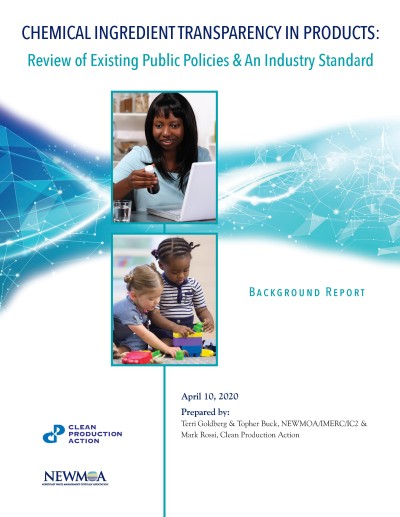
What’s in that bottle? New report reviews public policies for chemical ingredient disclosure

Announcement

State governments, which are at the frontline of fighting COVID-19, are also at the frontline of requiring businesses to disclose chemical ingredients in their products to consumers and public agencies. From California to New York consumers are… …

COVID-19 Update: A message from Clean Production Action

Dear Friends of Clean Production Action,   Like you, we watch the coronavirus news with growing concern.  We believe it’s critical to do our part to help reduce the spread of COVID-19.  To that end, and consistent with CDC… …

Announcing new ASBC-BizNGO partnership on Safer Chemicals Public Policy Work Group

Since its founding in 2006, Clean Production Action’s BizNGO, a collaboration of forward-leading business people and the NGO community, has sought to inform and influence federal and state chemicals legislation and regulation.… …

Newsletter October 10, 2019

Chemical Footprint Project rising in retail, ECHA hosting GreenScreen webinar (Oct 28)

SDGs & Chemical Footprint in retail.  Looking for tools to meet Sustainable Development Goal (SDG) #12 – Ensure sustainable consumption and production patterns? SDG Indicator 12.4 specifies the need to “achieve the… …

Newsletter September 12, 2019

Join BizNGO Annual Meeting December 10-11th

Conference to be held in downtown Boston In anticipation of BizNGO 2019 we wanted to: Provide details on the BizNGO 2019 agenda Highlight the 2019 accomplishments of the BizNGO Work Groups (WGs), including: Endocrine disruptors & chemical classes… …

US GAO Chemical Innovation Report

Technologies for Making Products and Processes More Sustainable. …

Stakeholder Initiative Seeks Common Ground on Public Policies for Chemical Ingredient Transparency

Clean Production Action (CPA) and the Northeast Waste Management Officials Association’s (NEWMOA) Interstate Chemicals Clearinghouse (IC2) are launching a partnership to find common ground among key stakeholders on chemical ingredient… …

The 2019 CFP Survey is live!

Show your leadership in proactive chemicals management and apply now to participate. …

Chemical Footprint Project updates & BizNGO meeting

CFP news & BizNGO Annual Meeting I wanted to share the latest updates from the Chemical Footprint Project, and to remind you about the BizNGO 2018 Annual Meeting. See below for details.  Chemical Footprint Project 2018 Annual Report… …

How to purchase PFAS-free food service ware

Fact sheets & resources on PFAS alternatives

Clean Production Action teamed up with Ann Blake Environmental & Public Health Consulting and GreenBlue as an initiative of the Cancer-Free Economy Network, a growing collaboration of 50+ organizations working together in aligned,… …

Surviving chemicals of concern lists

Online training begins June 13th The course includes three live, online, 75-minute classes: June 13th: Discover the global landscape of chemicals of concern lists, how they impact different sectors, and how stakeholders manage their lists.… …

Manage the chaos of chemical lists - webinar TODAY & more

Here are a few new resources from Clean Production Action and friends to support your journey to safer chemicals: Webinar TODAY: One stop shop for information on chemical hazards - The Data Commons 4 Introductory courses in chemicals management… …

RSLs, footprints, and safer alternatives

Need help understanding restricted substances lists (RSLs), measuring chemical footprints, or identifying safer alternatives? Here are some resources from Clean Production Action: 4 Courses on getting started with - Corporate chemicals policies RSLs… …

4 New Courses in Chemicals Management Leadership

Join Clean Production Action in addressing your pain points in chemicals and materials management. In 2018 we are offering 4 new courses that build from our expertise in proactive chemicals and materials management to develop the skills and provide… …

Five achievements from 2017

    In these times of federal roll-backs to human and environmental health protections, we thankfully still have companies keeping and upping their commitments to use inherently safer chemicals in products, manufacturing, and supply… …

IEHN joins Clean Production Action!

Dear Friends of CPA, It is with great pleasure that I share the news that the Investor Environmental Health Network (IEHN) is coming under the Clean Production Action umbrella. This is an exciting new chapter in our decade-plus partnership with Dr.… …

Newsletter: Upcoming webinars & BizNGO

    The leaves are changing here in Somerville which means BizNGO 2017 is right around the corner. This year, the annual meeting will be held on December 5-6 at the NonProfit Center in downtown Boston. Learn more and get your ticket here.… …

CFP Webinar & New Model Chems Policy

What do retailers, investors, and enviros have to do with solutions to hazardous chemicals? Surprisingly, it turns out, quite a bit. To give you a snippet of what is going on in the wave of solutions to unhealthy chemicals, here are some highlights… …

Get trained on GreenScreen List Translator™ & more from CPA

Dear partners in safer chemical advancement, I’ve been knee-deep in scoring 2016’s cohort of the Chemical Footprint Project Survey. Stay tuned for our annual report coming out in June; we have some exciting results. Of course, I… …

Newsletter: May 4, 2017

Greetings fellow advocates for safer chemicals, Here in Washington state Spring has sprung! Salmonberry flowers are blooming, grass is growing fast with the abundance of rain, and the Pacific wrens are singing their beautiful song. Clean Production… …

Newsletter: Clean Production Action launches GreenScreen Certified™!

Dear Friends of Clean Production Action,   I have so much news to share with you. Here are the quick highlights. We: Launched GreenScreen Certified™ today! Are hosting a webinar on April 26th with Garmon Chemicals. Added… …

Mark Rossi interviewed by Umass Boston Center for Green Chemistry

In December, Sumeyra and Daniela of Umass Boston met with Dr. Mark Rossi, Executive Director of Clean Production Action and founder of BizNGO, a leader in green chemistry initiatives. The interview is featured in Umass Boston's Green Chemistry… …

Clean Production Action December Newsletter

Thank you for being part of the Clean Production Action community! In 2016 we: released the first annual Chemical Footprint Project™ report with the support of investors, purchasers, and leading brands; deepened GreenScreen®’s… …

Join us in December and plan for 2017!

December 6 - workshop on the Chemical Footprint Project: learn how to develop and implement a safer chemicals management program December 7-8 - BizNGO 2016: join us for the 11th annual conference in San Francisco 2017 - GreenScreen®… …

Chemical Footprint Project Webinar & Workshop, & BizNGO 2016 Conference!

Webinar on the Chemical Footprint Project: get the latest updates on the 2016 Survey December 6 - workshop on the Chemical Footprint Project: learn how to develop and implement a safer chemicals management program ​December 7-8 - BizNGO… …

Chemical Footprint Project Survey is live! BizNGO Annual Meeting, & more updates

Chemical Footprint Project survey is live! BizNGO members: Join us for the 11th annual meeting ​GreenScreen® featured at Electronics Goes Green conference Chemical Footprint Project (CFP) survey is live! Join leading… …

Clean Production Action launches NEW online course

Today we are thrilled to announce the launch of our online GreenScreen® Standard Introductory Course! Join us and learn: the value and uses of GreenScreen, a scientific, robust, and transparent hazard assessment method how companies like HP Inc.,… …

UNEP Business Case, BPA in Cans, Walmart and chemical footprinting & more

UNEP refreshes The Business Case for Knowing Chemicals in Products & Supply Chains The United Nations Environment Programme recently refreshed the report, originally released in 2014, with new design elements and translations in Chinese, French,… …

UNEP Re-releases report

UN Environment Programme re-releases designed versions of The Business Case of Knowing Chemicals in Products and Supply Chains in Chinese, French, Spanish, & English - written by our very own Dr. Mark Rossi.  …

Clean Production Action is growing!

I am excited to announce a number of updates here at Clean Production Action: a role change for me, three new staff, and a new office in Europe. For my part, I am now the Executive Director of Clean Production Action. In the words of the Board of… …

BizNGO conference attracts thought-leaders committed to safer chemicals

The BizNGO conference, hosted by Clean Production Action, was mainly about Chemical Footprinting This was the 10th BizNGO conference and there was much to discuss and learn. BizNGO is one of my favorite conferences because there is such a… …

GOJO Announces Its 2020 Sustainability Goals at BizNGO

FOR IMMEDIATE RELEASE: CONTACT: Kelly McGlumphy, Public Relations Manager, GOJO Industries, 330.255.6986, McGlumpK@GOJO.com, www.GOJO.com The company’s Sustainable Value Strategies and Goals promote leadership and continuous improvement, while… …

Check us out in GreenBiz

A 10-year checkup on the quest to detox commercial products In the last 50 years, manmade chemicals have made their way into almost every industrial and manufacturing process-basically every commercial product. Synthetic chemicals have become the… …

Chemical Footprint Project Welcomes $2.1 trillion and more in support!

Contents: Transatlantic partnership attracts over $2.1 trillion in support Health care Signatories bring $70 billion in purchasing power to Chemical Footprint Project November 30, 2015: deadline for Responders’ participation Transatlantic… …

California Regulations & Alternatives Assessment - New Report & Webinar Today

Also, it's time to register for the BizNGO-Chemical Footprint Conference! Join us in Boston on December 8 & 9. Webinar TODAY! Safer Alternatives to Methylene Chloride in Paint Strippers Join us for… …

GreenBiz Blog: So long toxics: A builder’s guide to safer chemicals

Excerpt from the GreenBiz article: Health experts long have recognized the risks of individual and groups of toxic chemicals in building products, beginning with lead and asbestos and continuing to formaldehyde, volatile organic compounds, mercury,… …

Job Opportunities, Save the Date, and Mark Rossi in the Boston Globe

Job Announcements Clean Production Action is now hiring for two new positions:   GreenScreen® Program Manager: We are looking for a technically and scientifically skilled individual to fill the position of managing our GreenScreen… …

GreenBiz Blog: The $1.1 trillion question: What’s your chemical footprint?

Look no further than the financial and reputational travails of Lumber Liquidators for a stark example of the risks companies are exposed to when they have toxic chemicals in their products and supply chains. From February to May, the stock price of… …

$1.1 trillion in assets under management and purchasing power sign on to CFP!

Somerville, MA [June 19, 2015] — You’ve heard of a company’s carbon footprint.  Now it’s time for the chemical footprint. Despite growing regulatory efforts, businesses around the world continue to use chemicals of high… …

Trending Topics: Hazard? Risk? Do you know the difference?

A subject that comes up frequently in the context of managing and choosing chemicals, particularly for downstream users, is that of hazard and risk. With this piece we start what will be a series on the topic, particularly as it applies to… …

Treading lightly with chemicals

A new tool, the Chemical Footprint Project (CFP), aims to establish meaningful measurement of overall corporate performance towards safer chemicals in products and supply chains. Dr. Mark Rossi, project lead and co-founder of NGO Clean Production… …

A Framework to Guide Selection of Chemical Alternatives

Concerns about the health and environmental impacts associated with some chemical products and processes have motivated a growing number of national, state, and local governments, manufacturers, and retailers to develop assessments and approaches for… …

Shifting FR Markets

The FRs market is experiencing a massive transformation in chemistry. As of 2013, bromine manufacturers no longer manufacture and use decabromodiphenyl ether (decaBDE) in the U.S. according to the bromine industry association—Bromine Science… …

Firemaster

One of the most studied of the new FRs is Firemaster 550—a bromine and phosphorous-based compound. Firemaster 550 highlights include:  Used in polyurethane foam products, including seating applications, as an alternative to the now… …

New & Emerging BFRs–Where are the tox data?

But what are manufacturers offering instead of decaBDE and HBCD, also on the phase out pathway due to its restriction by the Stockholm Convention on Persistent Organic Pollutants? Albemarle, Chemtura, and ICL are the leading producers of BFRs… …

BFRs in Electronics & Electrical Devices

Electronics and electrical devices account for 50% of global brominated flame retardant (BFR) consumption. The dominant end uses of BFRs in electronics are in cabinets, housings and printed circuit boards—together they account for roughly 80%… …

Alternatives: Are FRs Necessary?

A critical approach to chemicals in products in general and plastics in particular is to ask: Is it necessary? For example, is a flame retardant in nap mats even necessary? Driven by government regulations and industry standards, manufacturers now… …

Whack-a-chemical

Government policies drive, somewhat ironically, both the use and restriction of FRs. International, regional, national, state, and local fire safety regulations and flammability standards drive demand for FRs. At the same time the trend in government… …

Facts on Flame Retardants

Global consumption in 2012: 3.9 billion pounds (lbs). With consumption expected to increase to 5.2 billion lbs by 2018 for a compound annual growth rate of 5% for the next five years. (BCC Research) Government regulations, with a major push from FR… …

Health Effects of Flame Retardants (FRs)

FRs and their adverse health effects are a seemingly ubiquitous topic in scientific journals. Today we provide a snapshot in the table below of the primary health effects of widely used flame retardants. This is a summary table of a few FRs. For… …

Strategies for Identifying Safer Alternatives to Plasticizers

The solution to hazardous plasticizers like DEHP is not necessarily another plasticizer. The figure to the left from the Plastics Scorecard identifies five solutions to the use of chemicals of concern in plastics. Companies, for example, are… …

Solutions to Hazardous Plasticizers

The dominant movement in the marketplace is to alternative plasticizers to DEHP and other phthalates. Yet this is the less preferred solution to avoiding PVC and plasticizers altogether. Some recent assessments on alternative materials and… …

Recent Studies—Health Effects of Phthalates

The Consumer Product Safety Commission (CPSC) Chronic Hazard Advisory Panel (CHAP) on Phthalates released its final report in July. Its literature review suggests that prenatal phthalate exposure may contribute to male reproductive developmental… …

Chemical disclosure policies

It’s now the law in: Vermont: Act No. 188 (S 239) requires manufacturers of children’s products to notify the State if the product contains a chemical of high concern and empowers that State to prohibit the sale of or require labeling of… …

Flame retardant & PBT (persistent, bioaccumulative and toxic) restrictions continue to prosper

It’s now the law in: Maryland: HB 229 bans children’s products containing the flame retardants TDCPP (tris(1,3-dichloro-2-propyl)phosphate) and TCEP (tris(2-chloroethyl)phosphate). New York: AB 4741 / SB 3703 bans children’s… …

California to ban plastic bags

Coming soon: California: SB 270 would make the State the first to enact a statewide ban on plastic bags. The bill passed the Assembly & Senate (on the Governor’s desk for action by September 30th). Note: each county in Hawaii bans plastic… …

Assessing progress in greening electronics

According to the latest Greenpeace report, brands are making progress in reducing polyvinyl chloride (PVC) plastic and brominated flame retardants (BFRs) in products. Apple is leading the pack in completely eliminating these chemicals in personal… …

Health care wants furniture without unneeded flame retardants

Brominated and other flame retardants are losing the health care market. Four health care providers -- Advocate Health Care, Beaumont Health System, Hackensack University Medical Center, and University Hospitals -- announced they will stop buying… …

Target and Walmart cleaning up the supply chain?

The two US retail giants joined together with their supply chain last week in Chicago at the “Beauty and Personal Care Products Sustainability Summit.” At the top of their agenda: “impacts of chemicals (health &… …

Is edible packaging sustainable?

Some novel innovations aimed at reducing waste have been garnering attention this summer, including one pioneered by the company WikiFoods, Inc. The company describes its new material, WikiPearl, as “a protective electrostatic gel formed by… …

Washington State initiates action on PCBs as concern grows about contamination in pigments and dyes

While the 1976 Toxic Substances Control Act (TSCA) banned new production and most uses of polychlorinated biphenyls (PCBs), it allowed some historical uses to continue and set allowable limits for PCBs that occur as manufacturing by-products in other… …

Cleaning up the supply chain: Apple limits hazardous chemicals in manufacturing

Apple placed restrictions on benzene, beryllium, n-hexane, trichloroethylene (TCE), and other chlorinated solvents in manufacturing operations as part of its new Regulated Substances Specification.  Apple also says “All suppliers subject… …

Cleaning hands but contaminating the Great Lakes

A new report from the Canadian Environmental Law Association (CELA) and Clean Production Action (CPA) uses GreenScreen® to evaluate two antibacterial chemicals and concludes that triclosan is a high hazard chemical whose use should be avoided. An… …

BizNGO Applauds Senator Merkley’s Bill to Reduce PBTs Press Release

Businesses praise bill to avoid chemicals of high concern to human health and the environment Business leaders today urged the U.S. Senate to pass the Protecting America’s Families from Toxic Chemicals Act of 2014. The bill just introduced by… …

New bill would ban BPA from food and beverage containers

Senator Edward J. Markey (D-MA) and Representatives Lois Capps (D-CA) and Grace Meng (D-NY) have introduced the Ban Poisonous Additives (BPA) Act to bar the use of bisphenol A (BPA) in food and beverage containers nationwide in both reusable… …

Not just BPA: 175 chemicals of concern found in food packaging

A new report from the Food Packaging Forum identifies 175 potentially hazardous substances used legally in food contact materials. According to the report, many of these substances  – chemicals used in food packaging or to produce those… …

California fines Bumble and Bumble, Walmart, and others for VOCs in products

Hair and nail care products are contributing to smog: The California Air Resources Board has fined 19 companies for selling consumer products that violate air quality standards for smog-producing volatile organic compounds (VOCs). The products… …

“Flame retardants are everywhere”

Plastics in turn, are a leading end use for flame retardants. They’re found in penguins and in mothers, breast milk and children across the United States; in household dust, ordinary supermarket food and in virtually every geographic location… …

Plastics Scorecard

The Plastics Scorecard demonstrates how companies need to pay attention to the chemicals in plastics and the end of life impacts of plastics. For companies looking to reduce their environmental footprint, including their use of hazardous… …

Washington State finds “regrettable flame retardant substitutions”

Why companies need to do hazard assessments of alternatives … Testing for flame retardants in general consumer and children’s products by the state’s Department of Ecology found many “regrettable substitutions.” … …

US EPA releases final TCE risk assessment—2nd final assessment in 38 years under TSCA authority

Since 1976, when Congress enacted the Toxic Substances Control Act (TSCA) the EPA released its second final risk assessment for trichloroethylene (the first risk assessment covered asbestos). It focuses on the health risks from TCE exposure through… …

UNEP says measuring plastics use will reduce companies’ environmental impacts

Environmental impacts of plastic use are a business liability, says a new report from the Plastic Disclosure Project, United National Environment Program and business consultants Trucost. By quantifying plastics use, the report suggests, companies… …

Illinois bans plastic microbeads in personal care products

Who thought it was a good idea to put small, plastic beads that last forever in products that go down the drain? Illinois Governor Pat Quinn signed the nation’s first bill banning the manufacture and sale synthetic plastic microbeads in… …

France urges quick action on Endocrine Disrupting Chemicals (EDCs)

Europeans continue to expect government leadership on toxic chemicals. France has told the EU:  It’s time to act. There is ample scientific evidence that endocrine disrupting chemicals are harming human health. Disagreements and delays on… …

Adidas 99% PFC-free by 2017

On the path to halogen-free products … Sportswear manufacturer Adidas announced that its products will be 90% perfluorinated and polyfluorinated chemical (PFC) free by June 15, 2014, 99% PFC-free by 2017 and 100% PFC-free by 2020 – and… …

Clothing brands commit to limiting chemical releases

Companies participating in the Zero Discharge of Hazardous Chemicals Program (ZDHC) have commited to limiting discharges of about 150 hazardous chemicals used in manufacturing. The companies have already agreed to eliminate nonylphenols, halogenated… …

Panera Bread says “no” to artificial food additives

Panera Bread announced that food served in its 1800 bakery-cafés will be free of artificial additives by the end of 2016. Panera says this decision is part of its ongoing commitment to clean ingredients and transparency. Artificial trans fats,… …

Kaiser Permanente says “no” to flame retardants in furniture

Are flame retardants necessary for furniture? Acting in response to the association of flame retardants with cancer, reproductive, developmental and other adverse health effects, Kaiser Permanente announced it will no longer buy furniture containing… …

France warns against exposure to five widely used reproductive toxicants and endocrine disrupting chemicals

The French Agency for Food, Environmental and Occupational Health & Safety (ANSES) is calling for reduced exposure – particularly for pregnant women and in the workplace – to three widely used chemicals recognized as reproductive… …

“Forget precaution, get to production”

Lowell Center for Sustainable Production examines the “precarious promise” of engineered carbon nanotubes (CNTs) Despite uncertainty about their environmental and health effects, technologies relying on CNTs have developed at warp speed,… …

Who manufactures substances of very high concern? See latest report from ChemSec for investors

Oil and gas companies top the European NGO, ChemSec’s latest report on companies manufacturing “substances of very high concern” – SIN (Substitute It Now) chemicals. Likely to face future bans or restrictions in the EU due to… …

Fate of nanomaterials: Is it surprising to discover that nanotubes can be released from plastics?

We have long known that supposedly inert chemicals in plastics can break away from the finished product, exposing people and the environment to their health hazards. Flame retardants, plasticizers and monomers like Bisphenol A (BPA) are all… …

Minnesota becomes first state to ban triclosan

While the antibacterial ingredient known as triclosan continues to be used widely in soaps, toothpaste and other personal care products, Minnesota has passed a law making it the first state to ban the chemical from such items. Scientific studies have… …

Vermont Governor expected to sign bill regulating chemicals in children’s products

Vermont is poised to join California, Maine, and Washington State with more comprehensive chemicals policy legislation. The Vermont legislature passed a bill giving the state Health Department authority to require disclosure of… …

Flame retardants weakened frogs’ immune systems

Frogs exposed to PBDE flame retardants during early life developed weakened systems, a condition that could leave them vulnerable to disease, say University of Wisconsin scientists. Their study – the first of its kind – suggests… …

Sprint to sell iPhone cases made from methane-based plastic

Sprint has announced it will soon begin selling iPhone cases made from a methane-based plastic known as AirCarbon™. Manufactured by Newlight Technologies, the plastic is made with methane captured from dairy farms and touted… …

NAS: A Framework to Guide Selection of Chemical Alternatives

The National Academy of Sciences Engineering and Medicine released a guide for avoiding regrettable subsitutions to toxic chemicals in 2014. …

UN Global Chemical Outlook

Introducing UNEP’s Global Chemicals Outlook UNEP, in close collaboration with OECD, WHO and other organisations of the Inter-Organization Programme for the Sound Management of Chemicals (IOMC), is developing a Global Chemicals Outlook to frame… …

Green Chemistry and Safer Stuff

If it's on the store shelf, it's been tested and found safe, right? In this podcast with Annie Leonard of the Story of Stuff, Bev Thorpe of Clean Production Action talks about the hidden chemical dangers in everyday products and how green… …

IC2 Alternatives Assessment Guide

The Interstate Chemicals Clearinghouse (IC2) and participating states announced the release of the IC2 Alternatives Assessment Guide in January 2014. …